
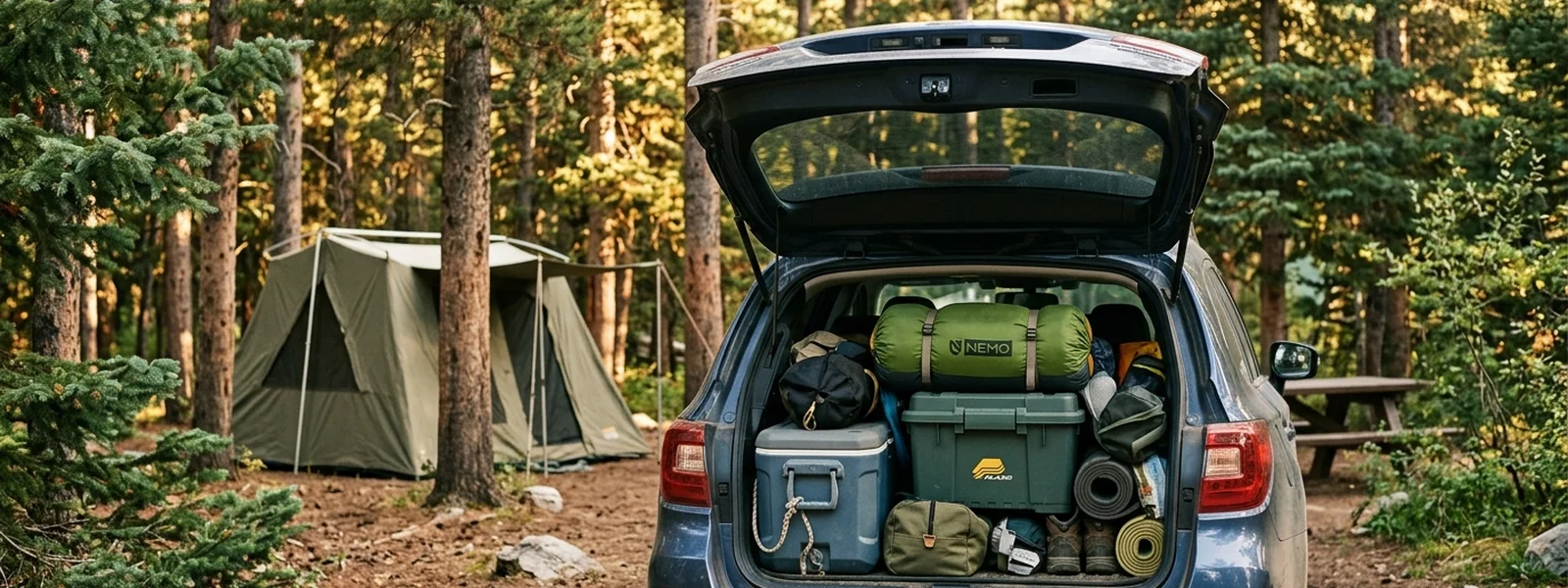
Looking Up After the Fire Dies Down
You have pitched the tent in the fading light. You have cooked a questionable meal over the fire. You have already had the mandatory argument about the best way to stack firewood. Now it is dark, the fire is burning down to embers, and the woods are quiet. What is next? You look up. That is the beauty of the camping night sky. Away from the streetlights and the glow of the city, the sky puts on a show that you just cannot get from your backyard.
But if you are anything like us, you probably look up, point at a bright dot, and confidently tell your friends it is Mars. Meanwhile, it is slowly blinking and moving toward Cleveland because it is actually a Boeing 737. You want to know more about what you are looking at, but you do not want a college astronomy lecture. You need a guide to stargazing for beginners.
We started Camp Life Shirts because we wanted camping gear that actually feels like camp — not some slick outdoor brand trying to sell you a lifestyle. We camp in state parks, cook questionable meals over a fire, and argue about the best way to stack firewood. These shirts are for people like us. We also spend a lot of time sitting in cheap folding chairs, staring at the sky, and trying to figure out where the Big Dipper went. This guide is built from those nights.
The First Rule: Finding a True Dark Sky
To see stars, you need dark. Real dark. Not just "the streetlamp on my block is burned out" dark. You need to get away from light pollution. If you are reading about stargazing for beginners, this is the most critical step. You cannot learn the sky if you can only see four stars through the city haze.
Before you book your next campsite, check a light pollution map online. These maps use a color-coded system to show you where the dark skies hide. State parks are usually decent. National forests and remote BLM lands are even better. You are looking for areas shaded in blue, gray, or black on the map. If you are camping in a spot shaded red or white, you are going to see more satellite dishes than constellations.
Even at the campsite, you need to manage your local light. Turn off your lantern. Shut off the headlights on your truck. If you are reading Tent vs. RV Camping: Which One is Actually Better?, keep in mind that RV parks are notoriously bright. If you are in an RV, you might need to walk a few minutes away from the campground loop to find a dark clearing.
The Moon is Not Your Friend
The moon is great. It helps you find your way to the bathroom at two in the morning without tripping over a tent stake. But for stargazing, the moon is basically a giant flashlight ruining the show. A full moon washes out the sky completely, hiding the fainter stars and making the Milky Way invisible.
If you want the best view of the camping night sky, you need to pay attention to the lunar calendar. Plan your stargazing trips around a new moon. During a new moon, the sky is as dark as it gets. If you cannot swing a new moon trip, look for a waxing crescent or a waning crescent.
You can also time your viewing. If the moon does not rise until midnight, you have a solid window of dark sky right after sunset. If the moon sets at 10 PM, set your alarm for midnight and enjoy the dark sky until dawn. Timing is everything when you are fighting a giant glowing rock.
Patience and the Magic of Red Light
Your eyes are incredible, but they are slow. It takes your vision about thirty to forty-five minutes to fully adjust to the dark. During this time, your pupils dilate to let in more light, and a chemical called rhodopsin builds up in your eyes to boost your night vision.
Here is the catch: a single flash of bright white light instantly destroys that chemical buildup. Your night vision resets to zero. That means no looking at your phone. No staring directly into the campfire. And please, do not be the person who shines a massive tactical flashlight into your friend's face while asking them a question.
If you need to see what you are doing, use a headlamp with a red light setting. Red light has a longer wavelength and does not break down your night vision. You can read a star map, find your coffee mug, and adjust your chair without ruining your view of the sky. Almost all camping headlamps have a red mode now. Learn how to turn it on without cycling through the blinding white strobe setting first.
How to Find Constellations: The Easy Stuff
You do not need to memorize the entire sky to have a good time. Knowing how to find constellations is mostly about learning a few anchor points and using them to navigate. Start with the easiest, most recognizable shapes.
The Big Dipper and the North Star
The Big Dipper is the ultimate cheat code to the night sky. It looks like a giant soup ladle. In the northern hemisphere, it is visible almost all year long. Once you find the Big Dipper, you can find the North Star (Polaris).
- Locate the Big Dipper in the northern sky.
- Look at the two stars that form the outer edge of the ladle's bowl. These are called the pointer stars.
- Draw an imaginary line through those two stars and follow it upward.
- The first moderately bright star you hit is Polaris, the North Star.
Polaris is not the brightest star in the sky, despite what people think. But it is important because it sits almost exactly above the North Pole. Everything else in the sky appears to rotate around it.
Cassiopeia
If you follow that imaginary line from the Big Dipper past Polaris, you will run into Cassiopeia. It looks like a giant letter W or M, depending on the time of night. It sits directly opposite the Big Dipper. When the Big Dipper is low on the horizon, Cassiopeia is high in the sky.
Orion the Hunter
If you are camping in the fall or winter, Orion is your best friend. Look to the south for three bright stars in a perfectly straight, tight line. That is Orion's belt. Above the belt, you will see two stars forming his shoulders. Below the belt, two stars form his knees. The top left shoulder is a massive red supergiant star called Betelgeuse. It has a distinct orange-red color that is easy to spot with the naked eye.
Let Your Phone Do the Work: Best Stargazing Apps
You do not need to carry a massive paper star chart into the woods anymore. Your smartphone is the most powerful astronomy tool you own. Knowing the best stargazing apps makes identifying planets, stars, and satellites incredibly easy.
Apps like SkyView, Star Walk 2, and Stellarium use your phone's GPS and gyroscope to map the sky. You just hold your phone up, point it at the sky, and the screen shows you exactly what you are looking at. If you see a bright dot and wonder if it is Jupiter or Venus, the app will tell you instantly.
- SkyView: Great for absolute beginners. It has a clean interface and draws cool pictures over the constellations so you can see the "hunter" or the "bear" instead of just random dots.
- Stellarium: A bit more advanced but incredibly accurate. It is the gold standard for amateur astronomers.
- Night Sky: Excellent augmented reality features that blend the star map with your actual surroundings.
Just remember the rule about night vision. Before you open these apps, turn your phone brightness all the way down. Better yet, go into the app settings and turn on "Night Mode" or "Red Light Mode." This turns the entire screen red, saving your eyes from the harsh glow of the screen.
Leave the Telescope, Bring Binoculars
When people get interested in the stars, their first instinct is to buy a telescope. Do not do it. Telescopes are expensive, heavy, and fragile. They take up half the trunk of your car. Setting them up in the dirt while swatting mosquitoes is a frustrating way to spend an evening.
For a beginner, a standard pair of binoculars is infinitely better. You probably already have a pair sitting in a closet. Binoculars give you a wider field of view, making it easier to find things. They are lightweight, require zero setup, and you can pass them around the campfire easily.
Aim your binoculars at the moon first. The amount of detail you can see along the terminator line (the line between the light and dark sides of the moon) is incredible. You can see craters, mountains, and valleys. Next, point them at the middle star in Orion's "sword" hanging below his belt. That fuzzy patch is the Orion Nebula, a massive cloud of gas where new stars are being born. You can see it clearly with cheap binoculars.
Dressing for the Drop
Stargazing involves a lot of sitting perfectly still. When you stop moving, you stop generating body heat. And in the woods, the temperature drops fast after midnight. A night that felt warm at 8 PM will have you shivering by 1 AM.
Layering is key. Start with a moisture-wicking base layer. Throw on a heavy, comfortable hoodie. We are big fans of hoodies that smell faintly of campfire smoke. Wear a beanie, even in the summer, because you lose a lot of heat from your head. Wool socks are non-negotiable. Your toes will be the first things to get cold.
If you want to stay out for hours, bring a blanket to throw over your lap. If you lean more toward comfort and are reading What is Glamping? A Guide for the Comfort-Focused Camper, you might even want to drag your sleeping bag out of the tent and wrap yourself in it. There are no fashion points awarded in the dark.
The Camp Chair Setup
Looking straight up for an hour is a great way to get a massive neck cramp. The standard upright camp chair is terrible for stargazing. You need something that lets you lean back.
Reclining camp chairs are ideal. If you do not have one, pull the foam sleeping pad out of your tent and lay it flat on the ground. Lying flat on your back gives you a panoramic view of the sky without any neck strain. Just make sure you are far enough away from the fire ring that you do not catch a stray ember on your favorite jacket.
Position yourself so trees block any annoying lights from neighboring campsites. Give your eyes time to adjust. Pour a warm drink into an insulated mug. Keep your binoculars close by.
Catching a Meteor Shower
If you want to guarantee a good show, plan your camping trip around a major meteor shower. You do not need binoculars or apps for this. You just need a dark sky, a comfortable chair, and patience.
The Perseids happen every August and are usually the best shower of the year for camping. The weather is warm, and the shower produces a lot of bright, fast meteors. The Geminids in December are also spectacular, though you will need much heavier layers to sit outside and watch them.
When watching a meteor shower, do not stare at one specific spot. Just lie back and take in as much of the sky as possible. Meteors can streak across any part of your field of view.
Keep Looking Up
Stargazing is just another excuse to sit outside a little longer. It is a reason to let the fire burn down to embers, to appreciate the quiet of the woods, and to realize just how small we really are. You do not need to know the name of every star to enjoy the view.
Grab your hoodie. Grab a chair. Turn off your flashlight. Look up. The show is free, and it happens every single night.

Published by Camp Life Shirts
Wear the Wilderness
Frequently Asked Questions
What is the best time of night to stargaze while camping?
The best time to stargaze is usually after midnight when the sky is darkest and the air has cooled, reducing atmospheric distortion. However, any time after twilight ends is great, provided the moon isn't too bright.
Do I need a telescope to stargaze?
Not at all. A standard pair of binoculars is actually better for beginners. They are easier to use, provide a wider field of view, and are much easier to pack for a camping trip.
Why do people use red flashlights for stargazing?
Red light does not break down rhodopsin, the chemical in your eyes that allows you to see in the dark. Using a red light lets you read a map or find your gear without ruining your night vision.
How long does it take for your eyes to adjust to the dark?
It takes about 30 to 45 minutes for your eyes to fully adapt to the dark. Looking at a bright phone screen or a campfire will instantly reset this process.
What are the best stargazing apps for beginners?
SkyView, Star Walk 2, and Stellarium are highly recommended. They use your phone's sensors to map the sky in real-time, making it easy to identify constellations and planets.
How does the moon affect stargazing?
A bright moon acts like a giant flashlight, washing out fainter stars and the Milky Way. For the best stargazing, plan your camping trip around a new moon or a crescent moon.
First Look at New Camping Shirt Drops
New designs, camp tips, and first access to new camping shirts — straight to your inbox, no fluff.